LBI London recently caught up with Dr Alexander Brown, the Institute’s new Postdoctoral Fellow, whose research interrogates the complexities of Holocaust memory in the German Democratic Republic (GDR). Brown’s work, supported by the Leverhulme Trust, reconsiders long-held assumptions about antifascism, remembrance, and historical responsibility in the ‘other Germany’. We spoke about how his path led him to study GDR memory politics, what his project reveals about Holocaust commemoration behind the Iron Curtain, and how these debates still resonate in Germany and beyond.

Could you briefly outline your academic path and what drew you specifically to the GDR and its memory politics?
My academic training is in modern European history, with a particular focus on the politics of memory, ideology, and historical representation after 1945. I was drawn to the German Democratic Republic because it sits at the crossroads of several historical stories we often assume we already understand—antifascism, socialism, and Holocaust remembrance—and because those stories become far more complicated when viewed from the East German perspective. The GDR is frequently portrayed as a moral or historical failure, particularly when compared to West Germany’s post-1960s reckoning with the Nazi past. Yet when one looks closely at how East Germany actually addressed Nazi crimes in law, education, and commemoration, that familiar picture begins to fray.

What initially appeared to be a marginal or “failed” memory culture turned out to possess a distinct institutional logic and a historically traceable set of practices. The GDR’s approach to remembering the Holocaust was shaped by antifascism as a constitutive political framework—one that offered a very different way of thinking about responsibility, catastrophe, and legitimacy after 1945 from those that dominate post-1990 discourse.
This interest was sharpened by an early sense of dissonance between the dominant narratives about the GDR that I had largely internalised as a British historian and the ways many former East Germans spoke about their own pasts. That discrepancy raised fundamental questions: whose memories come to count as authoritative after political rupture? How do certain narratives harden into historical “common sense”, while others are marginalised or dismissed?
These concerns deepened through my early research on political opposition in the GDR and how it has been retrospectively constructed since 1990, and later through my work on the Ministry for State Security. Across these projects, I became increasingly interested in the politics of retrospective judgement and in the asymmetries of power that shape how socialist pasts are remembered, narrated, and moralised.
 What is the core argument of your Leverhulme project, “The Answer to Auschwitz”?: Holocaust Memory and Antifascism in the Other Germany, and how does it challenge established narratives of GDR Holocaust remembrance?
The central argument of the project is that Holocaust remembrance in the GDR cannot be adequately understood through the familiar lenses of suppression, propaganda, or ideological distortion alone. Instead, it shows that antifascism functioned as a genuine—if politically structured—framework for engaging with the legacy of Nazi crimes, including the persecution of Jews.
This challenges the widespread assumption that meaningful Holocaust memory only emerged in West Germany after the 1960s, and that East Germany’s engagement was necessarily secondary or deficient. While the project does not deny the idiosyncrasies of state-directed memory, it insists on taking the GDR’s own institutions, categories, and actors seriously as historical objects of analysis, rather than as foils for a West German normative model. In particular, it foregrounds the role of Jewish antifascists who were actively involved in shaping legal practice, education, and commemorative practices.

Your project combines archival research, interviews with Jewish citizens of the GDR, and analysis of cultural artefacts. Which type of source has most reshaped your thinking about GDR antifascism and why?
Archival sources—especially institutional files—reshaped my thinking most decisively. They reveal a level of sustained practical engagement with Nazi crimes, Jewish suffering, and questions of responsibility that is often absent from retrospective accounts. These materials complicate the assumption that Holocaust remembrance in the GDR was purely rhetorical or symbolic.
At the same time, interviews with Jewish citizens of the GDR, along with their memoirs and other forms of life writing, have unsettled any simple top-down picture of antifascism. They foreground lived experience, political identification, and agency, and show how individuals navigated, interpreted, and often embraced antifascist frameworks in their own lives. Working with these sources has also made it possible to bring into view Jewish voices that have been marginalised in post-1990 memory culture because they do not sit comfortably within dominant narratives of dissidence, victimhood, or repression.

Cultural production has also been crucial. Films by Konrad Wolf, DEFA documentaries, and novels such as Peter Edel’s Die Bilder des Zeugen Schattmann or Jan Koplowitz’s Bohemia — Mein Schicksal demonstrate how the Holocaust functioned as a persistent and meaningful reference point within East German cultural life. Far from being marginal or taboo, it was repeatedly addressed through cinema, literature, and public discourse.
Equally formative have been the National Memorial Sites established at authentic locations of Nazi terror, particularly Sachsenhausen, Ravensbrück, and Buchenwald. These former concentration camps became central spaces of antifascist commemoration in the GDR. The profound transformations in how these sites have been curated and narrated since 1990 also make them revealing lenses through which to examine unified Germany’s ongoing struggle to come to terms not only with Nazi crimes, but with the legacy of the GDR itself.
Taken together, these sources point to antifascism not as a monolithic doctrine imposed from above, but as a framework negotiated across institutions, cultural forms, and individual lives.
 How does your earlier study of Paul Merker and debates around “cosmopolitanism” in the GDR feed into your current work on Holocaust memory?
My research on Paul Merker and on debates surrounding the so-called “anti-cosmopolitan campaign” in the early GDR laid the groundwork for my current work by foregrounding how questions of Jewish persecution, internationalism, and antifascist legitimacy have been retrospectively interpreted and politicised. Rather than treating these episodes as settled evidence of antisemitism or repression, the book situates them within the political conflicts, investigative practices, and discursive frameworks of the early Cold War. In doing so, it complicates the conventional shorthand of an “antisemitic campaign”, not least by showing that many of the central participants in these debates were themselves Jewish antifascists, while the individuals retrospectively cast as targets or victims were overwhelmingly non-Jewish—including Merker himself.
A central aim of that study was to historicise the Merker affair and the language of “cosmopolitanism” without collapsing them into later memory paradigms. By reconstructing contemporary debates and archival records, it shows that what has retrospectively been presented as a coherent repressive episode in fact comprised several overlapping but analytically distinct dynamics. On the one hand, debates around “cosmopolitanism” were largely cultural and ideological in nature, concerned with questions of Western cultural orientation, perceived forms of cultural imperialism, and the boundaries of socialist internationalism, understood in the GDR as a relationship of solidarity between equal national cultures rather than subordination to Western models. On the other hand, security concerns developed independently of these cultural debates and focused on German exiles who had spent extended periods in the West, often under extreme material and political pressure, and were therefore investigated for potential compromise. These investigations followed a distinct institutional and evidentiary logic and should not be read as an outgrowth of the discourse on “cosmopolitanism”. The later fusion of these separate dynamics in historical memory has nevertheless shaped how the Merker affair is commonly interpreted.
These developments unfolded against the backdrop of early Cold War security anxieties, marked by widespread agent hysteria on both sides of the Iron Curtain and by genuine attempts at political infiltration and destabilisation. When placed in this context—comparable in its intensity, if not its institutional form, to McCarthyism in the United States—the retrospective construction of the Merker affair as an episode of antisemitically motivated “anti-cosmopolitanism” or “Stalinist showtrial” becomes difficult to sustain. Such interpretations, I argue, rely on the conflation of cultural polemic, security investigation, and later memory discourse, and on the selective mobilisation of evidence detached from its contemporary political setting.
This approach feeds directly into my work on Holocaust memory by reinforcing the need to analyse antifascism as a historically contingent political framework, rather than judging it through stabilised moral categories derived from post-1990 memory culture. It allows debates around Jewish persecution and responsibility in the GDR to be examined within their contemporary institutional and political context, while also shedding light on how these histories have subsequently been re-narrated in unified Germany.
In your work on the Knowing the Secret Police project, you inverted the usual focus on what the Stasi knew, to what East Germans knew about the Stasi. How has that perspective influenced how you now approach state power and public knowledge in your research?
That project reinforced my scepticism towards models of state power that assume total opacity and control on one side and passive ignorance or subjugation on the other. Applying this perspective to memory politics has meant paying closer attention to what people understood, debated, and contested within GDR society. In the context of Holocaust remembrance, this approach helps to recover forms of historical knowledge and moral reasoning that operated publicly and dialectically, even when they were influenced by state and party narratives. It shifts the focus from the familiar pattern of sensationalised exposé and revelation after 1990 to historical practices of knowing and acting at the time.
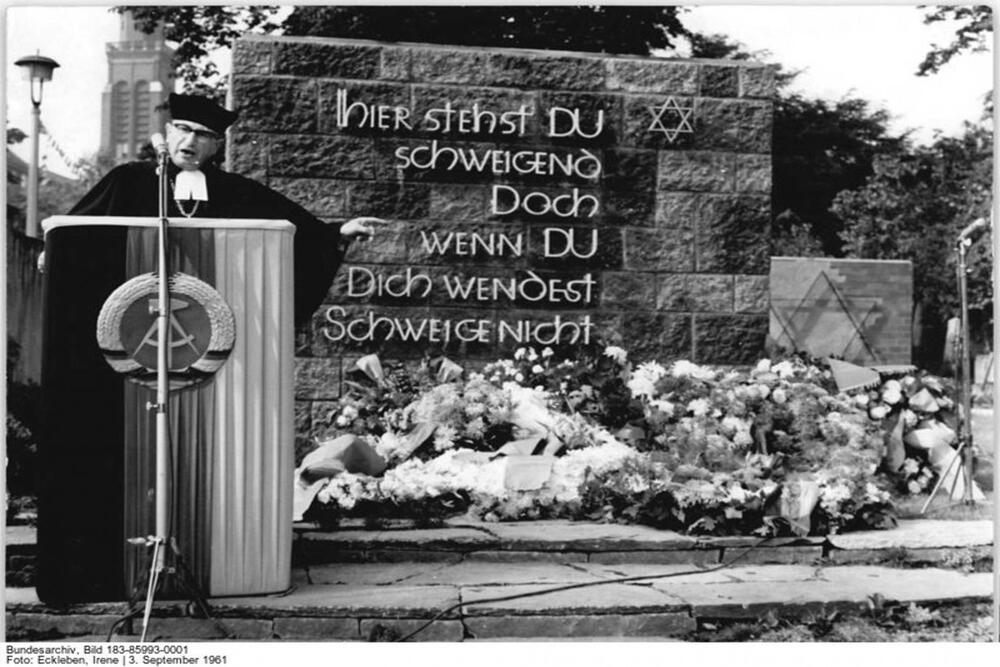
You teach extensively on Holocaust remembrance in both West and East Germany. What are the main challenges in conveying the specificity of the GDR’s antifascist memory culture to students or the wider public?
The main challenge is overcoming a deeply entrenched teleological narrative in which the Western Federal Republic represents moral and political maturation, while the GDR appears only as a deviation or failure. Students are often surprised to learn that the GDR pursued Nazi perpetrators through the courts, foregrounded antifascist resistance, and institutionalised aspects of what we would now term Holocaust remembrance to a greater extent than is commonly assumed and much earlier than many Western countries. Conveying specificity requires slowing down inherited judgements and reconstructing historical context before evaluation—without romanticisation, but also without retroactive dismissal.
Your work touches on the relationship between historical memory, antisemitism, and the politicisation of the Nazi past in post-1990 Germany. How do you navigate the tension between historical analysis and contemporary political debates?
I approach this tension by insisting on historical precision and conceptual clarity. My aim is not to adjudicate contemporary political positions, but to analyse how categories such as fascism, antisemitism, antifascism, and historical responsibility are mobilised in public discourse. Post-1990 Germany has seen the consolidation of powerful memory norms, and examining how these norms shape public discourse and historical interpretation in the present—including the resurgence of the far right—requires careful separation of historical analysis from moral shortcutting. The task of the historian, as I see it, is to complicate and contextualise rather than simplify.
During your year with the LBI, what kinds of collaborations, sources, or formats are you most interested in pursuing, and what questions would you particularly like to explore here?
During my year at the LBI, I am particularly interested in working with exile-related sources in both British and German archives that shed light on encounters between German-Jewish antifascists and British political, cultural, and intellectual institutions. The LBI with its collections and resources is the perfect home for this research and I look forward to tracing how experiences of exile shaped later engagements with antifascism, historical justice, and political belonging after 1945. I am also keen to examine how the GDR’s antifascist approaches to commemorating the Holocaust were perceived, interpreted, and debated in Britain during the Cold War.
I would welcome opportunities for collaboration with historians, literary scholars, and other cultural practitioners to examine antifascism as a historically situated and culturally mediated phenomenon, attentive to its institutional forms as well as its lived meanings, and to consider how these seemingly historical phenomena continue to have ongoing relevance for our world today.
In terms of format, I am keen to contribute to public-facing events and carefully designed digital outputs that communicate complex historical constellations effectively without simplification—particularly where Jewish political life in the GDR intersects with broader questions of exile, return, and belonging, as well as the longer afterlives of antifascist traditions.
Dr Brown’s research reminds us that history is rarely black and white. By examining how East Germans grappled with the Holocaust through the lens of antifascism, he challenges simplistic narratives of failure or success. In doing so, his work at the LBI prompts fresh questions about memory, responsibility, and belonging – not just in the GDR’s past, but in how we understand division and unity today. For more on his fellowship and related events, please check related pages on our website.
This interview is part of LBI Scholars in Conversation, a series exploring the work of our fellows, doctoral researchers, visiting scholars and members of the board and how their projects shed new light on modern Jewish and German history.